
Saul was a Benjamite, the son of Kish, and was only a young man, when he came to power. He is described as a handsome man and a head taller than anyone else in the land. Benjamin was one of the smallest tribes of Israel, with a troubled past and a history of revolt against the other eleven, so no one, least of all Saul himself, would have expected the first king of Israel to come from his tribe. One day he was out looking for his father’s lost donkeys when his search led him, almost by accident, into the presence of the prophet Samuel, as God had sent Samuel to the region of Gibeah to anoint the first king of the people of God.
About this time tomorrow I will send you a man from the land of Benjamin. Anoint him ruler over my people Israel; he will deliver them from the hand of the Philistines.
1 Samuel 9:16
Samuel anointed him privately first, pouring a flask of oil over his head, and gave him a set of signs to confirm that God had truly begun working in him. Every sign came true exactly as promised, and on his way home Saul met a procession of prophets and the Spirit of God came upon him so powerfully that he began prophesying alongside them. The people who knew him were stunned but even the transformation wasn’t enough to settle him, though. When Samuel later summoned all Israel to Mizpah to reveal the king by lot, and the lot fell on Saul, he was nowhere to be found. He was hiding among the supplies.
The man God had chosen and personally transformed still had to be dragged out to receive the kingship. That tension between the outer man and the inner one never really leaves Saul. Israel wanted a king who looked like the kings of the nations around them, and in Saul, God gave them exactly that. He looked the part completely. What remained to be seen was whether he had the heart to match it.
The Rise and Fall of Saul
Very early in his reign, Saul faced a familiar enemy and got an opportunity to prove why God had chosen him to lead Israel. When the Ammonite king Nahash besieged Jabesh Gilead and threatened to gouge out the right eye of every man in the town, Saul was seized by the Spirit of God and burned with anger. He summoned all Israel, led a decisive rout of the Ammonites, and was coronated before a jubilant nation. It was the high point of his reign, and the town of Jabesh Gilead never forgot it. Decades later, after Saul’s death, it was their men who marched through enemy territory at night to reclaim his mutilated body from the wall of Beth Shan.
The failures in his reign were many and began soon after his triumphant victory over the Ammonites. Facing a massive Philistine army at Gilgal, with his own soldiers trembling in caves and cisterns, Saul waited seven days for Samuel to arrive and perform the offering. On the seventh day, with his men slipping away, he lost his nerve and offered the sacrifice himself. But Samuel arrived just after and told him plainly that his kingdom would not endure, because of a lapse of maybe a few hours. It’s one of the more uncomfortable passages in the Bible, and on the surface it may seem like unfair standards from Samuel toward Saul, but there was deeper reason for Samuel’s anger.
Samuel’s grief over Saul was never really about the offering. It was about whose timing the king trusted more: his own reading of the battlefield, or the word of the God who had put him there. Compare that to David, anointed as a boy and made to wait nearly three decades—hunted and betrayed—before he ever wore the crown, and who twice had Saul’s life in his hands and refused to take it because it wasn’t God’s time. The difference between the two men was never opportunity, but patience, and waiting for God to act in His time.
Saul’s reign after that becomes a long study in going through the motions of faith while the substance of it quietly drains away. He keeps a priest at his side to carry the ephod, but only consults God when it’s convenient, and drops the pretense the moment the answer is too slow, telling the priest to withdraw his hand mid-inquiry so he can charge into battle on his own initiative. During one of the wars, he makes a rash vow cursing any man who eats before evening and it nearly costs him his own son Jonathan’s life. When his starving men break the vow and sin further by eating meat with the blood still in it, Saul’s response is to build his first altar to the Lord, not out of worship but as damage control, a sacred structure repurposed into a convenient stone for draining blood.
The clearest picture of what had gone wrong in Saul comes in his war against the Amalekites. The instruction from God was total and unambiguous. Saul, however, saw impracticality in God’s instruction as he spared Agag the king and the best of the plunder, and came home believing he had done exactly as he was told. He even built a monument to himself at Carmel to commemorate “his victory.”
But Saul and the army spared Agag and the best of the sheep and cattle, the fat calves and lambs—everything that was good. These they were unwilling to destroy completely, but everything that was despised and weak they totally destroyed.
1 Samuel 15:9
When Samuel confronted him, Saul didn’t own what he’d done rather he blamed the soldiers. And when he finally heard that the kingdom would be torn from his hands, his response wasn’t repentance but a request: come back with me and honor me before the elders of my people. Even at the moment of judgment, Saul’s deepest concern was how he would look in front of his own countrymen.
Does the LORD delight in burnt offerings and sacrifices as much as in obeying the LORD? To obey is better than sacrifice, and to heed is better than the fat of rams.
1 Samuel 15:22
Drifting Away from God
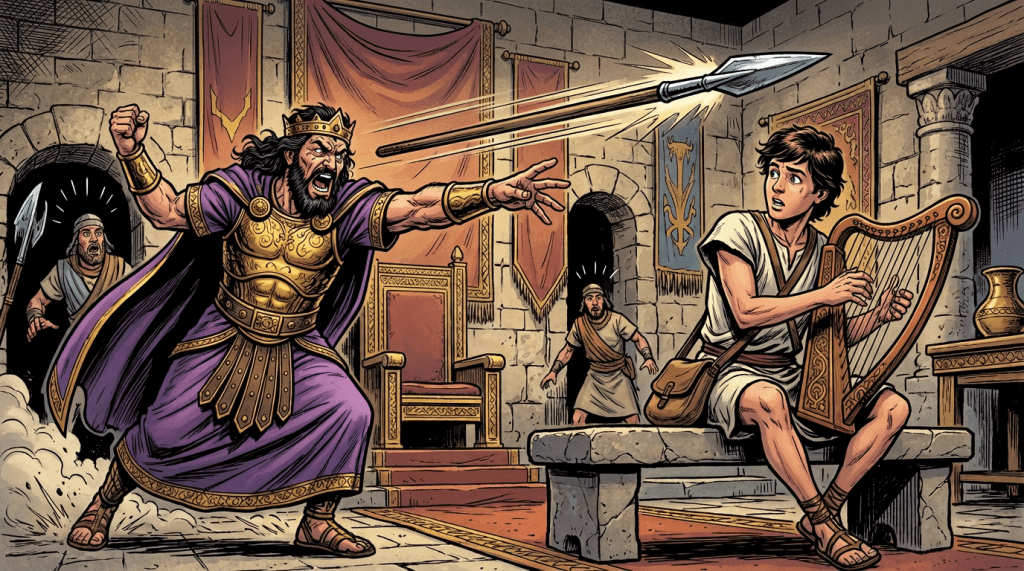
The Spirit of God departs from Saul, and an evil spirit begins to torment him. It doesn’t invent something new in him. It just stops letting him hide what was already there. When David plays the lyre to soothe him and Saul hurls a spear at him twice, that impulse to pin David to the wall was already sitting in Saul’s heart. What follows is a slow unraveling of a man who has lost control of everything, his soldiers, his kingdom, even his own children, who love David more than they respect their father. He tries to use both his children as bait against David and loses both gambits. He swears oaths in the name of the Lord he has already betrayed while plotting murder with his hands, a man for whom every outward form of faith remains intact while the heart underneath it has gone somewhere else entirely.
By the time the Philistines gather for what will be his final battle, Saul has cut himself off from every legitimate way of hearing from God, and in his desperation he seeks out a medium at Endor, breaking the very law against necromancy that he himself had enforced, disguising himself to sneak past his own borders and then dropping the disguise once he arrives.
The LORD has torn the kingdom out of your hands and given it to one of your neighbors—to David… tomorrow you and your sons will be with me.
1 Samuel 28:17,19
He dies the next day on Mount Gilboa, badly wounded, and rather than risk capture and humiliation at Philistine hands, he falls on his own sword. Even at the very end his fear isn’t for his soul but for his body, how his defeat will be displayed. The man who once spared an enemy king to parade him as a trophy dies terrified of becoming someone else’s trophy, and his fear turns out to be justified.
The next day, when the Philistines came to strip the dead, they found Saul and his three sons fallen on Mount Gilboa. They cut off his head and stripped off his armor, and they sent messengers throughout the land of the Philistines to proclaim the news in the temple of their idols and among their people. They put his armor in the temple of the Ashtoreths and fastened his body to the wall of Beth Shan.
1 Samuel 31:8-10 (NIV)
In his life, Saul never stopped going through the motions—the offerings, the oaths, the public shows of worship. What he never did, once the Spirit left him, was allow God’s actual will to interrupt his own plans. He wanted the approval of his people more than the approval of God, and in the end he was left with neither. That’s the warning his life leaves behind for us: it is entirely possible to keep every outward form of faith intact while the heart underneath has quietly drifted somewhere else, and looking the part was never going to be enough for Saul, nor will it be for us.






Reply