
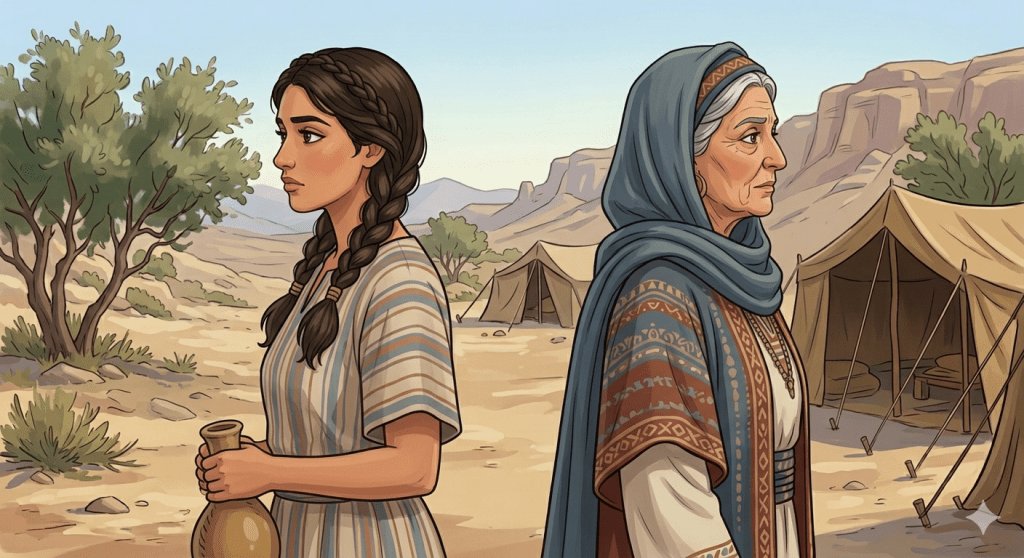
The Bible recounts the remarkable stories of two women — Hagar and Sarah — both of whom bore children to the patriarch Abraham. However, since Hagar was an enslaved woman, Scripture does not identify the people of God as her heirs, but rather as the heirs of Sarah, the free woman. This distinction is rooted in the promise God made to Abraham: that his descendants would be as countless as the grains of sand on the seashore and the stars in the sky.
The Promises
Now you, brothers and sisters, like Isaac, are children of promise.
Galatians 4:28 (NIV)
When we focus solely on what God said to Abraham regarding Isaac, we tend to overlook the promises God also extended to Hagar (Genesis 21:18) and her descendants. Just as God promised blessings to the descendants of Isaac, He equally blessed the descendants of Ishmael, for both were Abraham’s sons. This is affirmed in the following verse:
I will make the son of the slave into a nation also, because he is your offspring.
Genesis 21:13
God loves everyone, and thus His promises and faithfulness belong to all people on this earth. Through this promise, the descendants of Abraham were to be multiplied and blessed. Within this promise, Isaac is central; yet, it is notable that the free woman is not directly mentioned. Although she gave birth to Isaac, and we may naturally associate her with this promise, God was very specific about the promise made to Abraham regarding his descendants, some through Ishmael and some through Isaac.
The Slave Woman And The Free Woman
But what does Scripture say? “Get rid of the slave woman and her son, for the slave woman’s son will never share in the inheritance with the free woman’s son.”
Galatians 4:30 (NIV)
When we read the Old Testament stories, we attempt to journey back in time. The characters of the Old Testament lived out their lives and completed them. We, however, are living on this earth, and within the span of this life, we must exchange the salvation freely given to us by God for eternal life at the close of this mortal journey. Therefore, it is wiser not to retreat into their era but rather to align those stories with our present-day lives and their relevant context.
Furthermore, as Paul asked, “What does the Scripture say?” we must understand that Scripture has transparently recorded every character’s rights and wrongs. The words that came from their mouths were shaped either by an overwhelming love for God or by the weight of frustration they had endured. In particular, the verse quoted by Paul was spoken by Sarah in a moment of frustration.
But Sarah saw that the son whom Hagar the Egyptian had borne to Abraham was mocking, and she said to Abraham, “Get rid of that slave woman and her son, for that woman’s son will never share in the inheritance with my son Isaac.”
Genesis 21:9-10 (NIV)
The practice of being slow to speak and quick to listen remains the wisest policy — one that Scripture teaches us in many places. When Sarah forsook Hagar and Ishmael, God never abandoned them. Instead, He demonstrated His love and care toward them. God is the God of all people, yet we often assume that He works favorably in our lives while dealing harshly with others.
Children who grow up without parents are not abandoned by God — on the contrary, He cares for them in a special and tender way. Tragically, illegitimate children are often rejected and forsaken by society, as their existence may be seen as a disgrace to those responsible for their birth. But God never forsakes anyone, and He loves and cares for everyone. Somehow among religious Christians, a strong misconception is prevailing that God is their God and others are not under His jurisdiction, and thereby not deserving of His love and care. Many Christians forget their past state of slavery and how far God has helped them.
Man attempts to erase the stains of his wrongdoing in order to conceal his shame. Yet ultimately, God offered His own Son on the cross, and the blood of Jesus removes every stain—no matter how deep-rooted or long-standing it may be.
Born Out Of Flesh
There is nothing much to blame Hagar for giving birth to Ishmael. It is not her fault that she was born a slave, nor is it her decision to help her master by giving him a descendant; rather, it is the decision of her masters, Abraham and Sarah. The ill repute that people have of Hagar and Ishmael is baseless and even ridiculous, as the love of God is equally extended to slaves as it is to free people. Then what is the reason that the Bible discourages the people of God from becoming descendants of Hagar rather than of Sarah?
His son by the slave woman was born according to the flesh, but his son by the free woman was born as the result of a divine promise.
Galatians 4:23 (NIV)
There are two kinds of people on this earth: one those born of the flesh, and the other by the Spirit. Here, Ishmael is the outcome of Abraham’s disbelief in the promise of God to him, and Ishmael came into existence because of Abraham’s own desires of the flesh. Hence, the problem is not with the slave woman, but with Abraham, who became a slave to his own desires and rejected the promise of God by not comprehending the faithfulness of God in that promise.
Most believers remain ignorant of the truth because they struggle to grasp it when they hear the message or read the Word of God. Rather than thinking deeper, they simply set it aside, assuming it is beyond their capacity to understand. Instead, believers ought to read the Word repeatedly, earnestly pleading with the Holy Spirit to grant them insight, rather than neglecting large and significant portions of the Bible.
Abraham himself failed to fully comprehend the promise of God and consequently pursued his own desire—seeking an offspring to carry on his name. His example reminds us that whenever we choose to disobey God, we elevate the desires of our flesh and silence the leading of the Holy Spirit. To eliminate the desire of our flesh, Jesus asked us to deny ourselves and follow Him (Matthew 16:24).
The Conflict
At that time the son born according to the flesh persecuted the son born by the power of the Spirit. It is the same now.
Galatians 4:29 (NIV)
The continual problem with those born according to the flesh is that they continue to trouble those born by the Spirit. Paul noted these culprits and their actions and recorded them in his letter to the Galatians.
This matter arose because some false believers had infiltrated our ranks to spy on the freedom we have in Christ Jesus and to make us slaves.
Galatians 2:4 (NIV)
Paul was addressing the troublemakers who were compelling those born again by the Spirit to revert to the Law and submit to circumcision. This tendency to draw believers away from their spiritual life and back into a life of tradition is still very much prevalent today.
Jesus was born of the Spirit; yet even His mother, who bore Him, and His brothers were born according to the flesh. For this reason, they attempted to restrain Jesus from proclaiming the truth, even concluding that He had lost His mind. At that very moment, Jesus declared plainly that only those who fulfill the will of His Father are truly His brothers and sisters.
Jesus confirmed these words in a spectacular way when He entrusted His mother, Mary, into the care of His disciple, John. In doing so, Jesus ensured that His mother would remain with a son born according to the Spirit, thereby preventing her from being bound to His earthly brothers, who were born according to the flesh.
Jesus desires that we cultivate a spiritual family, even if it means setting aside our biological relationships. Many find themselves troubled by Jesus’ response to Martha’s complaint against her sister Mary. Yet that response carries a clear and unmistakable message — when it comes to God and His teachings, we must not allow our love for worldly siblings or family to draw us away from our place in His presence.
A Family For Those Born Of Spirit
The apostle Paul clarifies that before God, cultural, racial, religious, and ethnic backgrounds do not impact a person’s standing.
There is neither Jew nor Gentile, neither slave nor free, nor is there male and female, for you are all one in Christ Jesus.
Galatians 3:28 (NIV)
In God’s eyes, the distinction is not between a slave woman or a free woman — it is entirely about obedience. When we choose our own desires over God’s, we become slaves to those desires, which, in turn, open the door for the devil to use us for his purposes. However, when we willingly surrender ourselves as bondservants to God — having been bought at the ultimate price of His Son’s blood — we become children of the New Covenant.
Therefore, since we are surrounded by such a great cloud of witnesses, let us throw off everything that hinders and the sin that so easily entangles. And let us run with perseverance the race marked out for us, fixing our eyes on Jesus, the pioneer and perfecter of faith.
Hebrews 12:1-2 (NIV)
To fulfill our ultimate purpose of exchanging the temporal for the eternal, God has graciously prepared a sacred refuge where we may dwell in His presence, unburdened by the weights of this world. This spiritual family was established through the sacrifice of His Son upon the Cross, where He bound together those born of the Spirit into one spiritual family — opening the way for us to rest not in the ties of flesh and blood but in the everlasting embrace of our Heavenly Father, forever secured in Him.
When Jesus saw his mother there, and the disciple whom he loved standing nearby, he said to her, “Woman, here is your son,” and to the disciple, “Here is your mother.” From that time on, this disciple took her into his home.
John 19:26-27 (NIV)





Reply