

In the culture of ancient Israel, shepherds were some of the most familiar and meaningful figures in everyday life. Because Israel’s terrain consisted largely of hills, wilderness, and grazing land rather than fertile farmland, sheep herding was a common occupation. Many families owned flocks, and shepherding became an image deeply embedded in Israel’s language, leadership ideals, and spiritual understanding. Over time, this everyday role became a powerful way of describing leadership in Israel, and the nation’s rulers came to be known as the shepherds of Israel—particularly the kings and their officials, but also the priests and prophets who were responsible for guiding the people. Leaders were expected to care for God’s people as a shepherd cares for his flock, guiding, protecting, and nurturing them in faithfulness to the LORD. It was due to the failure of both the spiritual and political leaders that Israel had become separated from God.
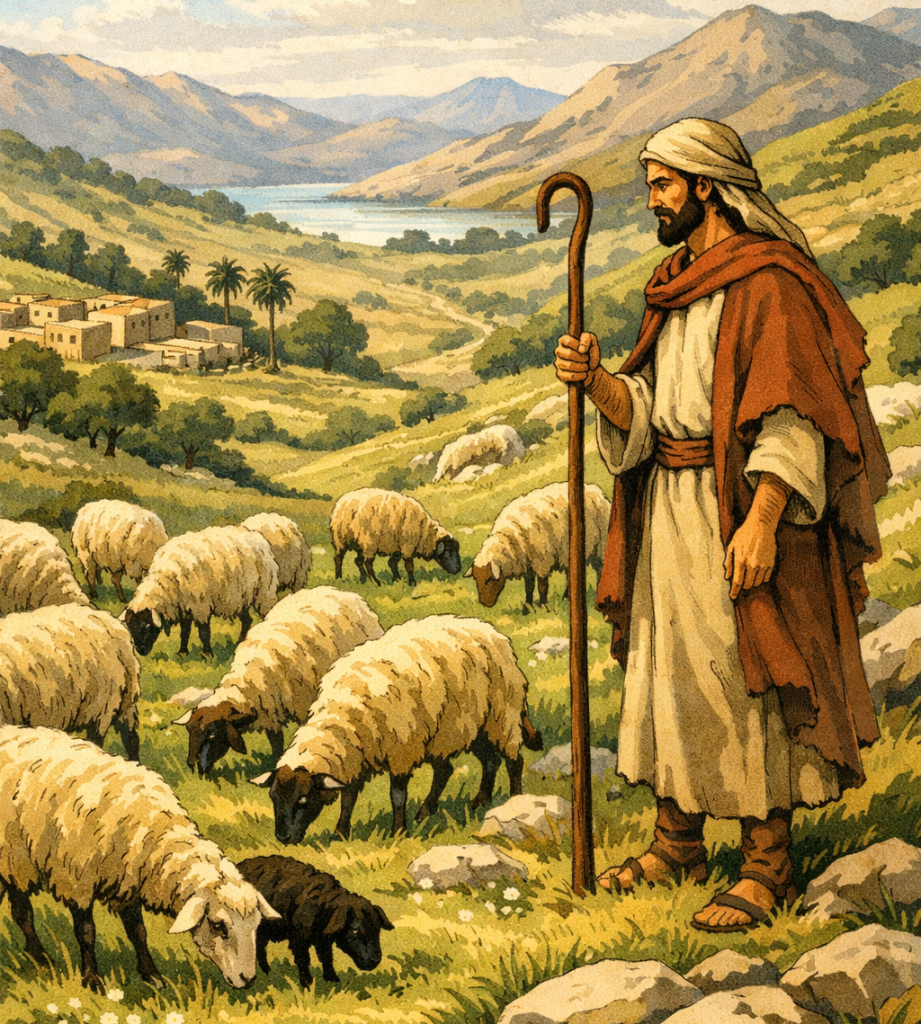
You have not strengthened the weak or healed the sick or bound up the injured. You have not brought back the strays or searched for the lost. You have ruled them harshly and brutally.
Ezekiel 34:4 (NIV)
Like Sheep to The Slaughter
God speaks through Ezekiel to rebuke the shepherds of Israel—the leaders entrusted with guiding and caring for the people. Instead of tending the flock, they used their positions for personal gain—eating the curds, clothing themselves with the wool, and slaughtering the choice animals—while neglecting their responsibility to care for the people.
Like selfish shepherds, the leaders of Israel sought to satisfy their own desires. They consumed the products that came from the flock without lifting a finger to care for it. They did not strengthen the weak, heal the sick, bring back the strays, or search for the lost, showing no concern for the well-being of the flock. Because they ruled harshly over the people instead of building them up, the flock was scattered. When problems came, the people became like sheep left vulnerable and wandering, with no one to seek them out or care for them.
So they were scattered because there was no shepherd, and when they were scattered they became food for all the wild animals.
Ezekiel 34:5 (NIV)
How does the flock of God come to be prey for the wild animals?
The flock of God becomes prey for the wild animals when they are left without a shepherd. Without a shepherd, the flock cannot distinguish good from evil, nor can they recognise who intends to harm them and who truly cares for them. In their confusion, they may begin to trust the very wild animals that will eventually devour them.
In a similar way, when people lose their proper connection to the shepherd, they begin trusting wolves in sheep’s clothing for their spiritual food. Instead of receiving true nourishment, they receive poisonous fruit from these false shepherds. As a result, they are misled and gradually become prey, leaving themselves open for evil spirits to take hold of them.
The shepherds of Israel placed their own desires before the needs of their flock. How can we avoid falling into the same mistake today?
Many times we expect some gain for ourselves when preaching the gospel. Even if it is not financial, we may seek fame or desire that people call us righteous workers of God. Another danger is that we begin justifying ourselves as God’s people in a way that elevates us above others. We may claim to be specially anointed and imply that others do not have the same anointing. In doing this, the focus shifts from caring for the flock to establishing our own image.
Sadly, today a similar pattern exists where shepherds are leading for commission or profit rather than having actual burden for the flock. The business of religion and the lure of the tenth of income of the flock, along with their unwavering loyalty, has given the modern-day shepherds unchecked authority and power that they have no qualms in using for their benefit. In the end, the sheep are left without actual fodder, the word of God, and they are lost and confused, not knowing that they are slowly wasting away, like sheep to the slaughter.
We must share the burden Christ showed for us when he came looking for us when we were lost and brought us back. But we have a worldly mindset that keeps us from truly loving the flock but envying and even sometimes hating them when they grow closer to God. We create barriers for them to come to God in the form of initiations such as baptisms and religious observances such as lent and fasting that make them feel inferior to us. When there is no true burden for lost souls, ministry becomes centred on ourselves rather than on those who need guidance. We can also begin to think that our wants are more important than the needs of the flock. Instead, we are called to deny ourselves, follow Him, and give priority to God while working for Him.
This is what the Sovereign LORD says: I am against the shepherds and will hold them accountable for my flock. I will remove them from tending the flock so that the shepherds can no longer feed themselves. I will rescue my flock from their mouths, and it will no longer be food for them.
Ezekiel 34:10 (NIV)
God declares that He Himself will become the shepherd of His people. Rather than leaving the flock under the care of failed leaders, the LORD Himself will go out and search for His sheep, revealing His care and concern for those who are lost. He promises to gather the scattered Israelites from the nations where they were dispersed—not only from Babylonia, but from many lands where exile had taken them. He will bring them back to their land, lead them to good pasture, give them rest, seek the lost, bring back the strays, bind up the injured, and strengthen the weak. This promise also points forward to Jesus, the Good Shepherd, who spoke of other sheep not yet known to His listeners, indicating that God’s saving purpose reaches far beyond what people expected.
I will judge between one sheep and another, and between rams and goats. Is it not enough for you to feed on the good pasture? Must you also trample the rest of your pasture with your feet? Is it not enough for you to drink clear water? Must you also muddy the rest with your feet? Must my flock feed on what you have trampled and drink what you have muddied with your feet?
Ezekiel 34:17-19 (NIV)
Who are the sheep that trample the pasture and muddy the waters for the rest of the flock?
The sheep that trample the pasture and muddy the waters are those among the flock who take more than they need for themselves. They graze excessively, consuming far more than what is required, and in doing so leave very little for the rest of the flock. As a result, the remaining sheep are left lean and without proper nourishment because what was meant for all has already been taken by a few.
Like the elder son in the parable of the lost son, who was unhappy when his younger brother returned home, we can sometimes feel uneasy when new sheep are added to the flock. Instead of rejoicing, we may begin to think that our role will diminish. At times we push others aside—those we perceive as a threat to our position in the church. This insecurity stems from not clearly understanding what our Shepherd, God, desires from us or from failing to grasp His mission. As a result, we can fall into a kind of competitive grazing, where our actions trample the pasture and muddy the waters for others, driving people away from the fold.
God declares that He will judge between the strong and the weak within His flock. Those who have oppressed and pushed aside the weak will be held accountable. The LORD promises to rescue His flock so they will no longer be exploited, and He will appoint One Shepherd (Jesus, born in King David’s lineage), to lead and care for them. Under this Shepherd, God will be their God, and His chosen Leader will rule among them.
A Covenant of Peace
God promises to establish a covenant of peace with His people, removing danger and providing safety and blessing in the land. He will send timely rain, make the land fruitful, and free them from oppression so they will live securely without fear. No longer will they suffer famine, exploitation, or the scorn of other nations. Through these blessings and restoration, the people will recognise that the LORD is their God, and they are the sheep of His pasture.
I will make a covenant of peace with them and rid the land of savage beasts so that they may live in the wilderness and sleep in the forests in safety… I will send down showers in season; there will be showers of blessing.
Ezekiel 34:25-26 (NIV)
What are the “showers of blessing” that God promises to His people?
The covenant of peace and living under the care of the Good Shepherd are the showers of blessing promised to God’s people. Many times these words are misconstrued—perhaps influenced by the famous gospel song—to mean that although we see God’s mercies all around us, we must still pray and plead for showers of blessing that people often interpret as riches and influence in this world. But that is not what God is offering His flock. The sheep enjoy true peace and security when they are with the Shepherd. God is offering to be our Good Shepherd—a role that no one in our lives has been able to fulfill—leading us to His pastures to graze and thereby giving us the peace that can only come from being with our Shepherd.




Reply