

After the fall of Jerusalem, Ezekiel was able to speak again, and the word of the LORD came to him once more. This time, however, the message was not directed toward Jerusalem or his own countrymen, but toward Israel’s noisy neighbours—nations that had watched her collapse with satisfaction and celebrated her downfall. The prophecies against the surrounding nations reveal that the LORD is not only the Judge of Israel, but the Judge of all nations.
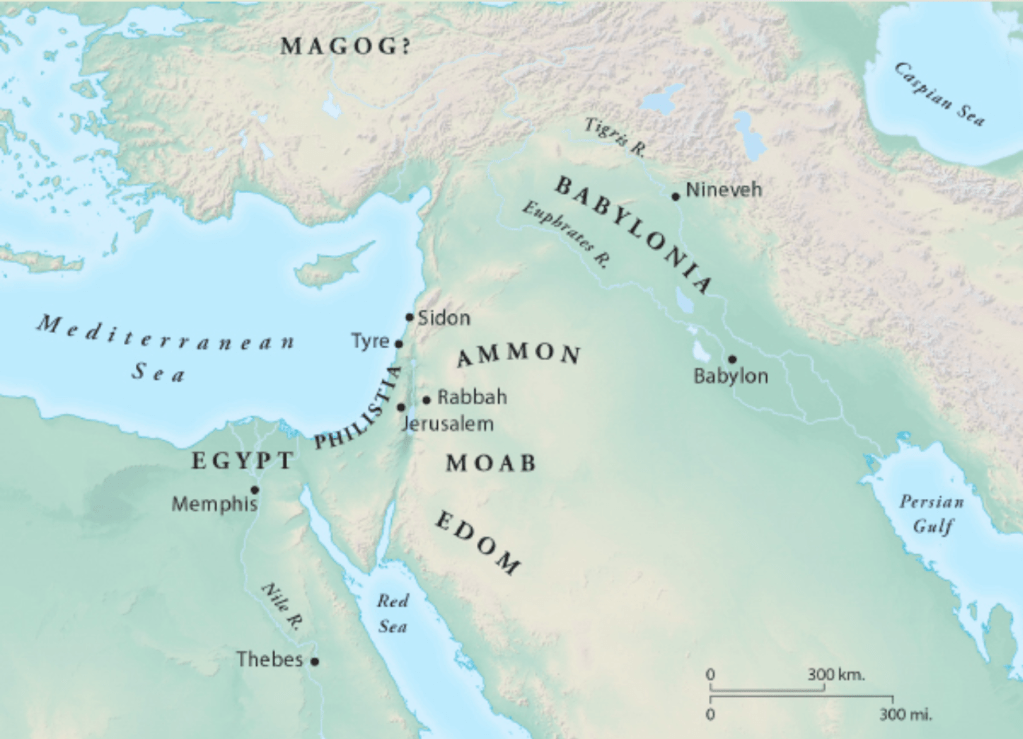
Ammon
Israel’s neighbors to the Northeast, the Ammonites were the descendants of Lot. They were always in opposition to Israel and reveled in idolatry. They rejoiced over the desecration of the sanctuary and were judged for mocking God’s people and celebrating their suffering.
Because you said “Aha! ” over my sanctuary when it was desecrated and over the land of Israel when it was laid waste and over the people of Judah when they went into exile, therefore I am going to give you to the people of the East as a possession.
Ezekiel 25:3-4 (NIV)
The LORD declares that they too will be handed over to eastern invaders and erased as a nation. Their capital, Rabbah, will become a pasture where camels graze and a resting place for sheep—a picture of complete desolation. Foreigners will consume their produce and enjoy the resources of the land. In this total overthrow, the nation will be wiped out, and they will realise that the LORD alone is God.
Moab
Next comes the land of Moab, situated to the east of Israel. David’s great-grandmother was a Moabite, and at one time David even found refuge in their land while fleeing from Saul. Yet beyond these isolated moments, there had long been hostility between the Moabites and the Israelites. They were idol worshippers who claimed that Judah was no different from the surrounding nations. In doing so, they denied Judah’s unique relationship with God—a relationship they themselves resented but ultimately rejected. Moab also aligned itself with the Babylonians in attacking Judah and took delight in her downfall. As with the Ammonites, the same fate awaited Moab: they would be handed over to the kingdoms of the east.
Edom
The Edomites lived to the south of Judah and were descendants of Esau, Israel’s twin brother and the elder son of Isaac. Their rivalry can be traced back to the womb, when the two brothers struggled even before birth, and that tension continued through their descendants. From their earliest beginnings, the two nations remained locked in persistent hostility.
Because Edom took revenge on Judah and became very guilty by doing so, therefore this is what the Sovereign LORD says: I will stretch out my hand against Edom and kill both man and beast.
Ezekiel 25:12-13 (NIV)
Instead of showing compassion to Judah’s refugees after the fall of Jerusalem in 586 BC, they attacked those who were fleeing and rejoiced over the destruction of the temple. Because of this, the LORD declares that He will deal with the people of Edom in anger and wrath. Through His vengeance, they will come to know that He is the God of their father Issac—the one they had long forgotten, the one true God.
Philistia
To the west of Israel lived the Philistines, the inhabitants of the coastal plain. They were among Israel’s most constant and aggressive adversaries, opposing them from the period of the judges through the early monarchy. Their hostility is vividly remembered in the battle between David and Goliath, a confrontation that symbolised the wider struggle between the people of God and those who defied Him. This long-standing enmity, marked by repeated conflict and resentment, ultimately shaped the Philistines’ response to Judah’s downfall and brought them under the judgement of the LORD.
This is what the Sovereign LORD says: ‘Because the Philistines acted in vengeance and took revenge with malice in their hearts, and with ancient hostility sought to destroy Judah
Ezekiel 25:15 (NIV)
Because the Philistines acted with long-standing hatred and sought revenge against Judah, the LORD declares judgement against them. He will stretch out His hand in wrath, bring destruction upon the Philistines, and wipe them out. Through this act of vengeance, they will come to know that He alone is the LORD.
Tyre and Sidon
Tyre and Sidon were two wealthy and influential seafaring Phoenician cities, renowned across the ancient world for their maritime skill and commercial reach. Tyre, the chief seaport of Phoenicia, occupied a strategic island location and stood at the centre of international trade. Its prosperity and reputation made it an economic superpower of its day and deeply arrogant. Rather than mourning Jerusalem’s fall, Tyre rejoiced in it, seeing Judah’s destruction as an opportunity for its own gain. Because Tyre gloated over Jerusalem’s ruin instead of showing compassion, the LORD declared Himself against the city.
In response to Tyre’s pride and self-confidence, the LORD announced that He would bring many nations against it, using Nebuchadnezzar king of Babylon as His instrument of judgement. Ezekiel describes Tyre’s downfall using a lament which turns abruptly from glory to ruin. The great trading city would be scraped bare and reduced to a rock in the sea, useful only for the spreading of fishing nets. The bustling hub of commerce would fall silent, its wealth plundered, its defences shattered, and its influence sunk like a wrecked ship beneath the waves. The prophecy reaches beyond the city itself to address the pride of Tyre’s king, declaring the collapse of both political power and self-exaltation. It concludes with a brief but decisive word of judgement against Sidon, affirming once more that the LORD alone rules over nations, cities, and kings.
The LORD judged the nations around Israel—Ammon, Moab, Edom, Philistia, Tyre and Sidon—not just for their actions, but for their hearts: their joy in Judah’s suffering, their pride, their desire for revenge, and their refusal to acknowledge the LORD as the true God. Each nation thought they were safe and justified, yet all were accountable to the same Judge. Their judgement shows that no nation or people are outside of God’s moral authority.
How do we respond to the downfall of our foe?
When our foe falls, the first and most honest question is not about them, but about our own hearts. These accounts force us to examine whether we take quiet satisfaction in the suffering of those we once resented. Even if we remain outwardly composed, inwardly we may feel relief, vindication, or even pleasure. Pride and old grievances subtly shape our response to the downfall of the people whom we believe wronged us.
We even justify our feelings by thinking God acts for us, believing, “God has taken revenge,” which mixes divine justice with our need for personal validation. Even being “neutral” can be wrong if it lacks Christ’s love. Ezekiel reminds us that God cares about our motives, not just our actions. Celebrating someone else’s pain or seeking revenge pushes us away from God. The right response to judgment—whether it’s against a friend or an enemy—is to be humble, respectful, and self-reflective. God is the only true judge. Our job is not to take delight in vengeance, but to protect our hearts, avoid pride, and respond with repentance and reverence for Him.



 The Jordan Valley
Reply