

After spending almost a year in the ark, Noah and his family were instructed by God to leave once the land had dried. They brought with them the animals, birds, and creatures, and were commanded to multiply and fill the earth. Upon exiting, Noah built an altar and offered burnt sacrifices of clean animals and birds to the Lord. God blessed Noah and his family, giving them a fresh start and the command to grow in number and populate the earth.
The fear and dread of you will fall on all the beasts of the earth, and on all the birds in the sky, on every creature that moves along the ground, and on all the fish in the sea; they are given into your hands. – Genesis 9:2 (NIV)
God gave humans authority over all animals, birds, and fish, causing them to fear humans as a sign of their new dominion over creation. However, despite this power, many are still misled by the ancient sea dragon, fearing satan and the fallen angels, and forgetting the dominion God has granted them over His creations. For the first time, God permitted humans to eat animals, marking a change from their previous plant-based diet, but with one condition.
But you must not eat meat that has its lifeblood still in it. – Genesis 9:4 (NIV)
God allowed mankind to eat the meat of animals but forbade them from consuming the blood of any creature, emphasizing the sanctity of life, symbolized by blood. Blood represents the life force in all creatures, both human and animal, and is a gift from God. He alone gives life and breathes it into us. By forbidding the consumption of meat with lifeblood still in it, God is underscoring the respect and reverence due to life itself.
Taking life for granted or shedding innocent blood, as seen in the actions of Cain and Lamech, is an affront to God’s authority and His plan for life. God affirms that each person will be held accountable to Him for the life of another, emphasizing the importance of respecting and protecting life, as it is sacred and given by God.
An Eye for An Eye?
Whoever sheds human blood,
by humans shall their blood be shed;
for in the image of God
has God made mankind. – Genesis 9:6 (NIV)
While this verse has been used by some to justify capital punishment, advocating for the execution of murderers and criminals, the message of Jesus offers a different perspective, often overlooked in the context of such debates. The “Eye for eye, tooth for tooth, hand for hand, foot for foot” principle (Exodus 21:24), which calls for justice, is frequently cited, but Jesus gave us a new standard based on mercy and forgiveness.
“You have heard that it was said, ‘Eye for eye, and tooth for tooth.’ But I tell you, do not resist an evil person. If anyone slaps you on the right cheek, turn to them the other cheek also.” – Matthew 5:38-39 (NIV)
Cain, after murdering his brother Abel, feared that others would seek to kill him in retaliation. Despite his grievous sin, God showed him compassion and placed a mark on him as a sign of protection, ensuring that no one would harm him. This act of mercy by God raises an important question: how can the same God, who extended grace and refused to let vengeance take its course, now command or permit humans to kill one another in other contexts?
God’s actions in protecting Cain highlight His mercy and justice—He did not immediately destroy Cain or allow others to avenge Abel’s blood. Instead, He placed the responsibility for judgment and consequences in His own hands. This act shows that God values life and restrains humanity’s natural tendency toward revenge. It was not God but human nature that has often pursued vengeance, blood for blood, and the cycle of retaliation.
When swift death sentences are carried out, the opportunity for the offender to experience forgiveness and grace is denied, leading not only to the destruction of their body but also their soul. Jesus warned “Woe to the one who causes one of these little ones to stumble,” and that it would be better for them to have a millstone hung around their neck and be drowned in the depths of the sea (Matthew 18:6). This emphasizes the serious consequence of preventing others from coming to God. Woe to us if we prevent someone from experiencing God’s grace and finding comfort in His mercy.
God commanded Noah and his sons to be fruitful, multiply, and fill the earth. He established a covenant with them, their descendants, and all living creatures, promising never to destroy life again with a flood. The sign of this covenant would be the rainbow, which God set in the clouds as a reminder of His promise. Whenever a rainbow appears, it will serve as a reminder of God’s everlasting covenant with all life on earth.
I have set my rainbow in the clouds, and it will be the sign of the covenant between me and the earth. – Genesis 9:13 (NIV)
I recently saw a rainbow up close, but it wasn’t in the sky—it was on the ground at one end, rising upwards. Because it was so close to me, it seemed like the most incredible thing I’d ever seen, a massive, vibrant rainbow. To the people in that town, it was nothing special, but to me, it was the most beautiful sight in the world. That rainbow had always been there, but it was only now that I truly noticed it. In a similar way, God placed an awesome wonder in the sky as a reminder to Noah and all of humanity: whenever you see it, remember that I love you.
The Generations From Noah
After the flood, Noah’s three sons—Shem, Ham, and Japheth—and their descendants repopulated the earth, establishing distinct nations with their own languages, territories, and clans. This likely occurred after the dispersion at Babel, where societies were scattered following their attempt to build a tower reaching up to heaven. From these three sons, all the people of the earth originated.
The Semites
Shem’s descendants settled in Mesopotamia and Arabia, becoming the ancestors of the Semitic peoples. They inhabited a region stretching from Mesha to Sephar in the eastern hill country. Shem’s sons were Elam, Ashur, Arphaxad, Lud, and Aram. The sons of Aram included Uz, Hul, Gether, and Meshek. Arphaxad was the father of Shelah, who was the father of Eber. Eber had two sons: Peleg, named because the earth was divided during his time, and Joktan, who fathered many descendants, including Almodad, Sheba, Ophir, and Havilah.
The Hamites
Ham’s descendants settled in North Africa and along the eastern Mediterranean coast, including regions such as Canaan and Egypt, and formed some of the world’s earliest civilizations. His sons were Cush, Egypt, Put, and Canaan. The sons of Cush were Seba, Havilah, Sabtah, Raamah, and Sabteka, while Raamah’s sons were Sheba and Dedan. Among Cush’s descendants was Nimrod, a notable figure described as a mighty warrior and hunter, who established prominent cities such as Babylon, Uruk, and Nineveh. Egypt’s descendants included the Ludites, Anamites, Lehabites, Naphtuhites, Pathrusites, Kasluhites (ancestors of the Philistines), and Caphtorites. Canaan’s descendants included Sidon (his firstborn), along with the Hittites, Jebusites, Amorites, Girgashites, Hivites, Arkites, Sinites, Arvadites, Zemarites, and Hamathites. The Canaanites later spread across territories extending from Sidon to Gaza and toward cities such as Admah, Zeboyim and the infamous twin cities of Sodom and Gomorrah,.
The Japhethites
Japheth’s descendants settled in Europe and Asia Minor, becoming the ancestors of many Indo-European peoples. His sons were Gomer, Magog, Madai, Javan, Tubal, Meshek, and Tiras. The sons of Gomer were Ashkenaz, Riphath, and Togarmah, while the sons of Javan were Elishah, Tarshish, the Kittites, and the Rodanites. The Japhethites became maritime peoples, spreading into their territories across various regions and languages, particularly throughout Europe and Asia Minor.
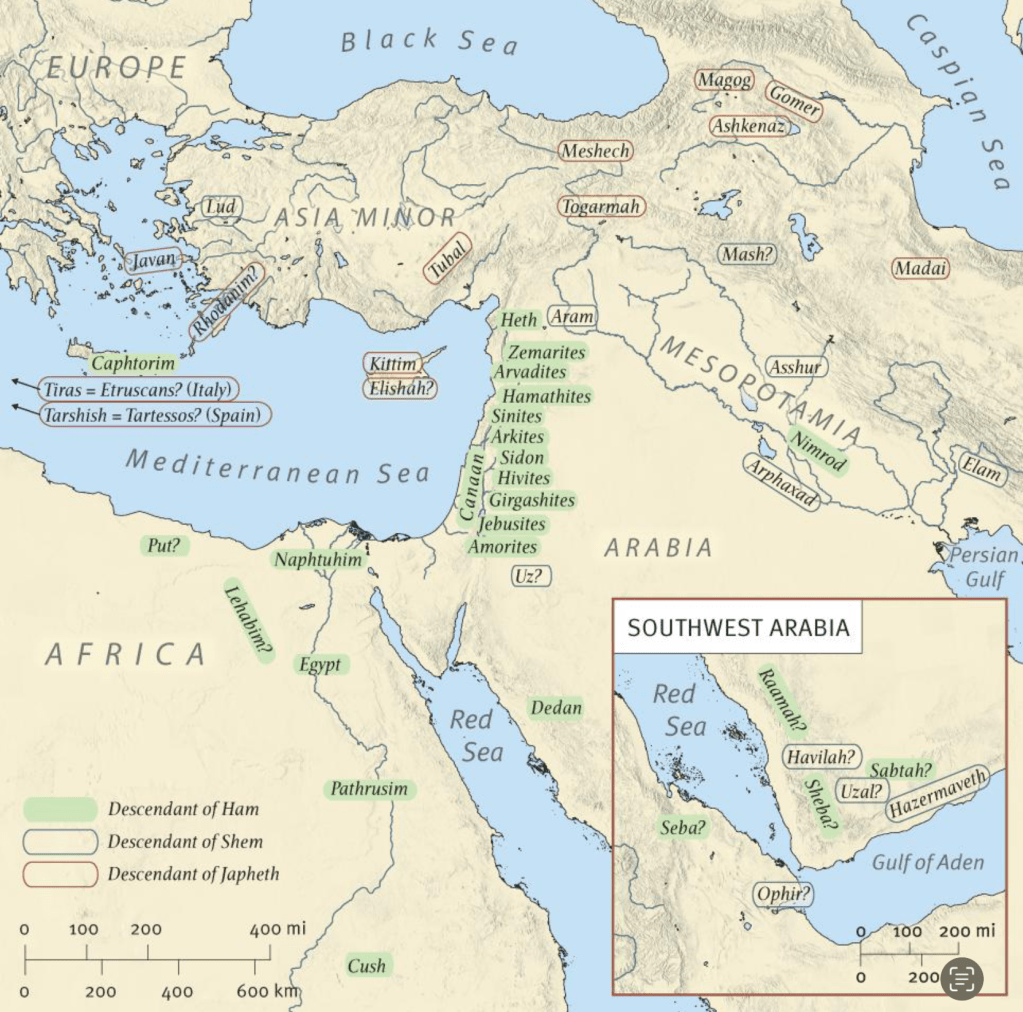
Noah Gets Drunk
After the flood, Noah planted a vineyard and became intoxicated from the wine he had discovered. This may have been the first instance of wine production, as the post-flood climate could have been ideal for fermentation. Noah’s drunkenness caused him to lie naked and exposed in his tent. When Ham, the father of Canaan, saw his father’s nakedness, he chose to inform his brothers rather than cover him. In contrast, Shem and Japheth acted with respect and decency, walking backwards into the tent to cover their father without looking at him.
When Noah awoke from his wine and found out what his youngest son had done to him, he said,
“Cursed be Canaan!
The lowest of slaves
will he be to his brothers. ” – Genesis 9:24-25 (NIV)
When Noah awoke and learned what Ham had done, he cursed Ham’s son, Canaan, to be the lowest servant to his brothers. Noah then blessed Shem and Japheth, asking God to expand Japheth’s territory and let him dwell in Shem’s tents, with Canaan serving both. Noah lived another three hundred and fifty years after the flood, dying at the age of nine hundred and fifty years.
Noah, in his drunken state, lost all awareness and didn’t realize he was naked. It seems unfair that he blamed his son for seeing him in that condition when it was Noah who had been drunk. However, the father-son dynamics at the time were likely very different. Ham’s failure to cover Noah or go to his brothers and recount his father’s drunken state would have been viewed as mocking his father or defying his authority.
In Ancient Near Eastern civilizations, the firstborn and lineage were of utmost significance. It is evident that Ham had sons at the time, yet instead of blessing them, Noah cursed Ham’s descendants, declaring they would be lifelong slaves to the descendants of his eldest son, Shem. This curse or prophecy doesn’t seem to have played out as Noah would have expected. Over the years, the descendants of Eber (the Hebrews) were subjected to constant slavery and oppression by various empires who ruled over them, and even today, Semitic peoples are still among the most oppressed groups in the world.
Misquoting Scriptures
Bible verses are often misquoted to justify harmful actions because people selectively interpret scripture to support their own agendas and prejudices. A historical example is how slavery in America and Europe was justified by quoting the curse on Ham’s descendants, misusing the Bible to claim that Black people were destined for servitude. This misinterpretation led to the forced displacement and enslavement of millions.
The Bible teaches that all life is precious to God, yet for centuries, Black people were denied basic rights, including the right to enter churches or be treated with dignity. Widows without sons were left destitute, their properties seized, and women were relegated to second-class status. Likewise, colonizers mistreated people from Africa and South Asia, all under the guise of divine approval.
In truth, such evil acts are not reflective of God’s will but are instead misinterpretations of scripture. The Bible reveals God’s heart of love, grace, and justice. Jesus came to teach us how to understand God’s heart, and the Holy Spirit guides us in discerning His will. Yet, too often, we rely on texts written by imperfect humans, who were shaped by their own biases and hatred, to justify our own sinful desires. In doing so, we replace God’s love and grace with our own selfish intentions.
To truly understand God’s will, we must go beyond a surface-level reading of the text and earnestly seek His heart in every verse. By delving deeper, we may come to see Him not as a distant or singular expression of judgment or mercy, but as the vibrant and multifaceted presence He is in our lives—a rainbow of grace, justice, love, and faithfulness. Just as a rainbow reveals a spectrum of colours, each reflecting light in its own way, so too does God reveal Himself in ways that speak to our hearts and circumstances. Each verse, when read with an open and seeking spirit, offers us a glimpse of His vast and unchanging nature, calling us to trust in the fullness of who He is.
Discussion Questions
- What was the reason behind God’s command to Noah not to eat the blood of animals?
- Is capital punishment for murder mandated by God or by human law?
- Why did Noah curse Canaan for what Ham did to him?
- Why are bible verses constantly misquoted to justify our evil intentions?


 The Jordan Valley
Reply