

After Abimelek’s reign of terror had ended, the land had peace for forty-five years. The reigns of Tola and Jair were largely uneventful in comparison but the latter’s death resulted in the Israelites returning to the gods of the land. They adopted the cultures and religions of their neighbours and started serving the baals of the world. Displeased with their actions, the LORD sold them into the hands of the Philistines and the Ammonites who shattered and crushed them for eighteen years. Then the Israelites realised their mistake and cried out to Yahweh to save them but God was in no mood to bring them out from their self-imposed misery and said,
…you have forsaken me and served other gods, so I will no longer save you. Go and cry out to the gods you have chosen. Let them save you when you are in trouble!
Judges 10:13-14 (NIV)
God is answering them but is not giving them the response that they want. They just want the end result rather than seeking a true change of their heart as they still hadn’t left their foreign gods. The Israelites kept on testing the patience of God, challenging Him to reveal new aspects of His grace. The theme of this book so far has been God’s grace on His people that helps them come out of the mess that they had created for themselves. But as soon as their misery was in their rearview mirror, they quickly traded in any semblance of a relationship that they had with Yahweh for the comfort and familiarity of false gods and idols.
There is no crime or sin that can separate us from God, except willing to go against His Spirit. The Israelites even after knowing the true path, deliberately chose to go their own way and betrayed God at every turn. There have been countless times when we had lost our way but God came to our rescue whenever we called on His name. But when we deliberately betray him and lead His flock also on the path of destruction, there will be no saving us from His wrath. As Jesus said, it would be better for them to have a large millstone hung around their neck and drowned in the depths of the sea (Matthew 18:15).
But the Israelites said to the LORD, “We have sinned. Do with us whatever you think best, but please rescue us now.” Then they got rid of the foreign gods among them and served the LORD. And he could bear Israel’s misery no longer.
Judges 10:15-16 (NIV)
Unlike the God of the heavens and the earth, the handcrafted idols could be carried along by the Israelites. The gods of baals and ashtoreths were especially credited with the fertility of both the woman and the land and thus were highly regarded. The leaders of the tribes could easily manipulate their people by controlling them with the fear of impotency that these gods supposedly warded off. The idols were easily accessible and gave them something tangible to hold on to. Moreover, these idols were the norms of the world that they lived in. Idols in the ancient world had great value due to the superstitions attached to them and the Israelites dared not go against the grain to follow Yahweh, who they could not manipulate according to their own whims and fancies.
Whenever we are disconnected from God we start concentrating on the God-given resources, leaving Him aside. In His absence, we rely on His provisions and idolise those in lieu of Him. Aaron chose the calf because he thought that the blood that he sprinkled to purify the altar had actual cleansing power. He did not realise that it was God who was purifying the priests and not some dead animal. Similarly, today, people who are disconnected from God, feel that they are connected to Him through praise and worship, specifically through music. Rather than focussing on the word and allowing God to speak to them, they keep Him at a distance and are using music as the golden calf to replace Yahweh.
The Gileadite Warrior
Now from the same tribe as Israel’s previous judge rose a mighty warrior named Jephthah. He was the son of Gilead but his mother was a prostitute. The sons of Gilead, perhaps fearing how Abimelek killed the sons of Gideon to rise to power, took a precautionary step and drove their half-brother, Jephthah away from the land.
“You are not going to get any inheritance in our family,” they said, “because you are the son of another woman.” So Jephthah fled from his brothers and settled in the land of Tob, where a gang of scoundrels gathered around him and followed him.
Judges 11:2-3 (NIV)
God works in strange ways as the next leader of Israel was not even allowed to be among his people during his formative years. He was driven away to live in the wilderness of Tob where he associated himself with evil men. If the sons of Gilead feared a repetition of the Abimelek story, then they were almost halfway there, as just like Abimelek, Jephthah had his own private army of unscrupulous men willing to do whatever it took to get the job done. Jephthah and his gang of scoundrels would have wreaked havoc as the news of their exploits reached the ears of the Gileadites.
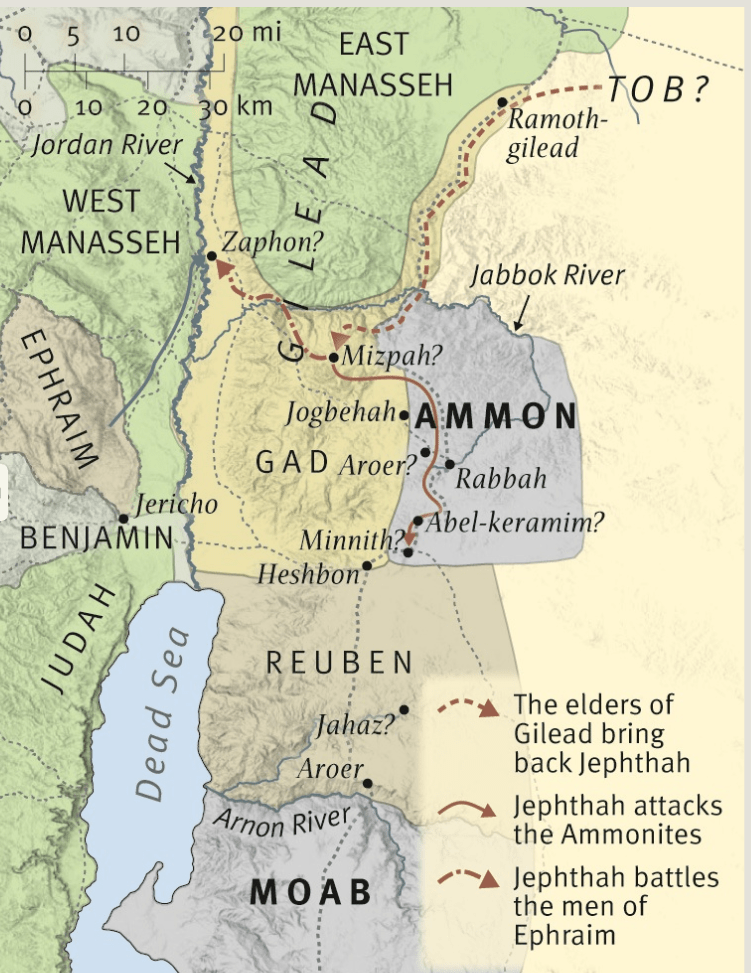
Some time later, when the Ammonites were fighting against Israel, the elders of Gilead went to get Jephthah from the land of Tob. “Come,” they said, “be our commander, so we can fight the Ammonites.”
Judges 11:4-6 (NIV)
When the Gileadites drove Jephthah away, they were concerned about their inheritance being shared with the bastard child of their father. Since the last judge Jair was their clansman it would be safe to assume that the thirty towns of Gilead that were under his control would have flourished during his reign. Their father would have amassed a considerable amount of wealth and his sons did not want Jephthah to receive any of their inheritance. But now the threat posed by the Ammonites was so great that they were willing to make Jephthah their leader if he could save their land from the destruction of the raiding parties.
By promising Jephthah the seat of leadership, the elders of Gilead convinced him and his men to fight for them. So the once bastard son of Gilead, who would have had no part in his father’s inheritance, was now not only back but would be the leader of Gilead and all the other tribes.
Negotiations with the Ammonite king
Jephthah tried reasoning with the Ammonite king who wanted Israel to peaceably return the territory that they had captured from his ancestors more than three hundred years ago. Jephthah sent word back to the king saying that it was not the Israelites who raided their land but were fending off the onslaught from Sihon’s army. It was during this encounter that God led Israel to victory and gave them the land in question.
Now since the LORD, the God of Israel, has driven the Amorites out before his people Israel, what right have you to take it over? Will you not take what your god Chemosh gives you?
Judges 11:23-24 (NIV)
Jephthah was exiled to the land of Tob and was forced to live away from his own people. He had no one to tell him about the Mighty One nor could he understand the heart of God. In his ignorance, he compares the actions of the true God with the regional god of the Ammonites. It was the same ignorance that leads him to make a hasty vow that resulted in the death of his family member.
When we confront the forces of this world with the power of God we must lean on His understanding and wisdom rather than making our own assumptions. Failure to do so will not only dilute the word of God but also make others think that it is on par with the manmade cultures of this world. The king of Ammon, however, paid no attention to the message Jephthah sent him.
The Hasty Vow
Then the Spirit of the LORD came on Jephthah. He crossed Gilead and Manasseh, passed through Mizpah of Gilead, and from there he advanced against the Ammonites. And Jephthah made a vow to the LORD: “If you give the Ammonites into my hands, whatever comes out of the door of my house to meet me when I return in triumph from the Ammonites will be the LORD’s, and I will sacrifice it as a burnt offering.”
Judges 11:29-31 (NIV)
Jephthah did not know the extent of God’s love and was trying to sweeten the deal by offering something that he thought God would want. He would have heard about Abraham’s willingness to sacrifice his son and he would have thought that God would appreciate such a sacrifice. When we are not listening to the voice of God and are driven by our own emotions, we end up doing things that God never asked of us.
Jephthah received the Spirit of the LORD to go to war with the Ammonites and be the deliverer of His people. Just because the Spirit of God is in us, it doesn’t mean that we will not fall into the traps laid out by satan. Jephthah’s spiritual immaturity is on display when he not only makes the vow but also decides to follow through on it. In both instances, we do not see him conversing with God to know His will. Rather, satan is using this opportunity to not only end Jephthah’s lineage but also create an incorrect perception in the hearts of the people regarding what God wants from them. The towns folk of Mizpah who witnessed the human sacrifice would have thought that their freedom came at the cost of a young girl’s life and would not have acknowledged God for showing His grace once again to them. The same happens with us when we mix our own assumptions when carrying out God’s work, as we dilute His mission and sometimes even go completely against His will.
The LORD gave the Israelites victory over the Ammonites, as Jephthah destroyed the towns from Aroer all the way to Abel Keramin. When he returned home from the battlefield, he had only one thing on his mind, to fulfil the vow that he had made to the LORD and which supposedly “convinced” God to help the Israelites defeat the Ammonites. Upon reaching his hometown of Mizpah, to his dismay, he was greeted by his only child. His daughter welcomed him as she danced to the sound of timbrels celebrating her father’s conquest. Devastated, he broke the news to her of how he had made a vow to sacrifice the first thing that came out of his house in order to secure victory for Israel.
“My father,” she replied, “you have given your word to the LORD. Do to me just as you promised, now that the LORD has avenged you of your enemies, the Ammonites. But grant me this one request,” she said. “Give me two months to roam the hills and weep with my friends, because I will never marry.”
Judges 11:36-37 (NIV)
In those days a woman’s prime responsibility was the continuation of the race. That entailed not only breeding of as many children as possible but also looking after the well-being of her family members. Jephthah’s daughter was denied this opportunity as she was not able to accomplish the very purpose of her existence. We were all put on this earth to accomplish the will of God but do we show the same remorse when we are not able to accomplish the purpose of our existence?
Jephthah let her daughter roam the hills for two months before making good on his vow to God. He was not listening to the voice of God but following the traditions of human sacrifices followed in that part of the world. We sometimes do not understand God’s will for our lives and start making our own assumptions based on the norms of the sinful world around us.
A Civil War with the Ephraimites
The Ephraimites gathered their forces and were ready to go to war with Jephthah for not including them in his battle plans when he took down the Ammonites. They were threatening to burn down the house of the man that had brought peace to the land at the cost of his own daughter’s life. Unlike Gideon, Jephthah did not try to calm down the agitators but riled them up with threats of his own.
Jephthah then called together the men of Gilead and fought against Ephraim. The Gileadites struck them down because the Ephraimites had said, “You Gileadites are renegades from Ephraim and Manasseh. …Forty-two thousand Ephraimites were killed at that time.
Judges 12:4 & 6 (NIV)
Even though Jephthah is being led by God, he himself is not listening to the voice of God. His inability to seek answers from God cost him the life of his daughter and now, he is ready to kill the people of his own country. From the point of view of the Giliadites, when the Ephraimites were needed, they were a no-show but when had brought victory to Israel, they were angered that they were left out from the successful mission. People are happy to join when the outcome of an outreach program is headed to success but would not want to put any work into building something that God wanted from them.
Jephthah led Israel for six years and when he died, he was buried in one of the towns of Gilead, a place that had rejected him due to no fault of his own, now embraced him for being the deliverer of Israel.
Discussion Questions
- Why is God not answering the cry of His people? Does he do the same with us?
- What is the lure of these fake gods that Israel kept holding on to them when they had access to the real One all along?
- Why did the Gileadites seek to bring back the person that they themselves had driven away?
- “Now since the LORD, the God of Israel, has driven the Amorites out before his people Israel, what right have you to take it over? Will you not take what your god Chemosh gives you?”
By saying this isn’t Jephthah acknowledging the existence of the Amorite god chemosh? Do we fall into the same trap with the prince of the world? - After receiving the Spirit of the Lord, how can Jephthah make such a vow to sacrifice a human being?
- Is not being able to marry worse than having to die because of a stupid vow someone else made?
- Why did the Ephraimite forces get into a war with Jephthah, a man being led by God?


 The Jordan Valley
Reply